

Machu Picchu’s guided visit runs about 2.5 hours, and in that window your guide walks you through a handful of specific structures that anchor the whole site: the Temple of the Sun, the Intihuatana stone, the Temple of the Three Windows, the Main Plaza, and the Royal Quarters. Which of these you actually see depends on which circuit your ticket covers, since the site’s one-way routes don’t all pass the same structures. This article walks through what each one is, why it matters, and which circuit gives you access to it. For the rest of what a visit involves beyond these structures, see our complete Machu Picchu guide.
How the site is divided: agricultural and urban sectors
Machu Picchu splits broadly into two zones: an agricultural sector, built as a series of stepped terraces used to grow crops and stabilize the mountainside, and an urban sector, where the temples, plazas and residential structures sit. Most first-time visitors picture the urban sector when they think of Machu Picchu, but the terraces you walk past on the way in are just as deliberately engineered, built to manage drainage and erosion on a site with almost no flat ground to begin with. The structures covered in this article all sit within the urban sector, and it’s this part of the site your guide focuses on during the standard 2.5-hour visit.
The Temple of the Sun
The Temple of the Sun is one of the finest examples of stonework at Machu Picchu, built around a natural rock outcrop rather than on a cleared foundation. Its curved wall is fitted with a level of precision that stands out even among the site’s other structures, and a small window aligned with the June solstice sunrise suggests the building had an astronomical function tied to the Inca solar calendar, not just a ceremonial one. It’s widely treated as one of the most sacred structures on-site, reserved for a narrower religious purpose than the surrounding residential and administrative buildings.
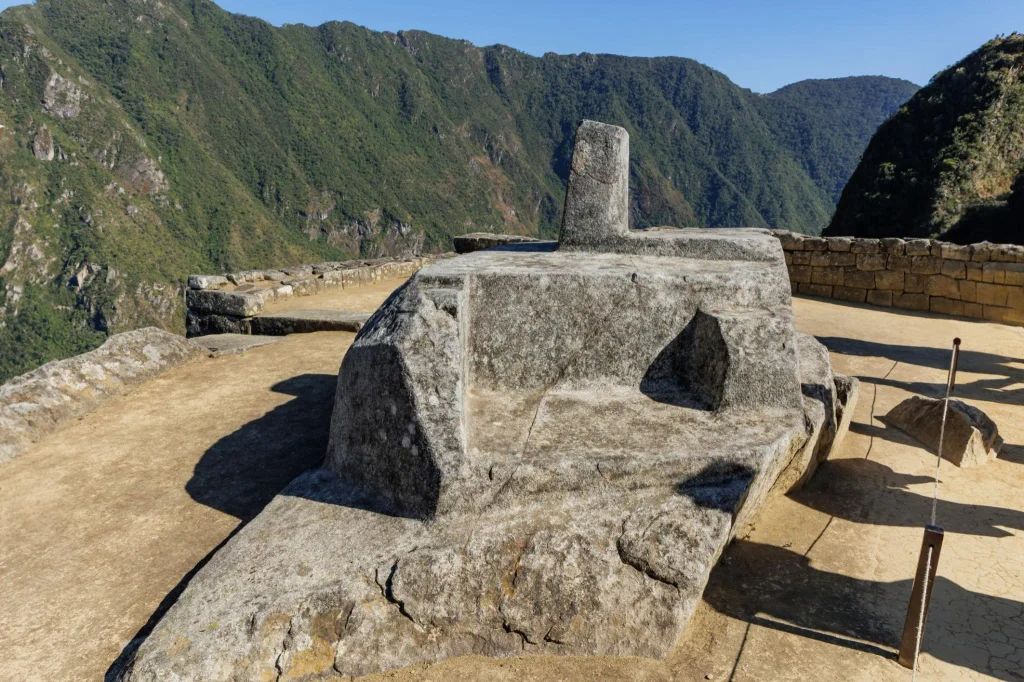
The Intihuatana stone
The Intihuatana is a carved stone pillar positioned on a raised platform, and its name is generally translated as something close to “hitching post of the sun.” It’s one of the structures most directly tied to the astronomical theories about the site’s purpose, with its angles and positioning widely interpreted as marking solar events through the year rather than serving a purely decorative role. Structures like this are part of why Machu Picchu’s function is still debated rather than settled — the Intihuatana reads as deliberately engineered for observation, not just as an architectural centerpiece. If the deeper worldview behind structures like this interests you, Andean cosmovision explained covers the belief system that likely shaped its purpose.
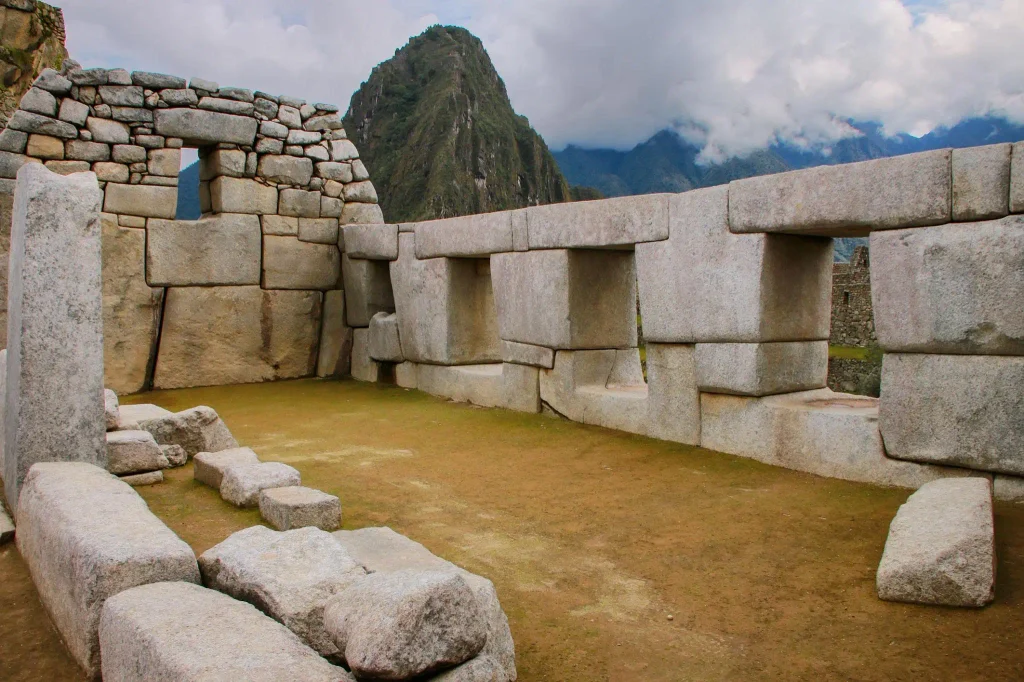
The Temple of the Three Windows
The Temple of the Three Windows is a trapezoidal stone structure with three large window openings framing views out over the valley, built with the same fitted-stone technique found throughout the site’s most important buildings. Some interpretations tie the three windows symbolically to the three levels of the Andean cosmos, though as with much of Machu Picchu’s specific symbolism, this remains an interpretation rather than a documented certainty. It sits close to the Main Plaza, making it one of the more accessible highlights on a standard walk through the urban sector.
The Main Plaza and the Royal Quarters
The Main Plaza is a large open space near the centre of the urban sector, generally understood as a gathering area separating the more sacred structures from the residential and administrative ones. The Royal Quarters, nearby, are a cluster of buildings with notably higher-quality stonework than the surrounding structures, which is one of the reasons researchers associate this section with Pachacutec’s own residence during his time at the site — part of the broader royal-estate theory covered in who built Machu Picchu. Walking between these two areas gives a clear, physical sense of how the site separated ceremonial, residential and public functions.
If seeing these structures in person is the goal, our 2-day Machu Picchu tour from Cusco is the most direct way to get there with a guide who can walk you through each one.
The stonework: why it survives
What holds a lot of these structures together, literally, is the ashlar technique used throughout Machu Picchu’s most important buildings: large stones cut and fitted together so precisely that no mortar was needed between them. This method gives the walls a degree of flexibility that rigid mortared construction doesn’t have, which is part of why so much of the site has survived centuries of seismic activity in a genuinely earthquake-prone region relatively intact. The quality of this stonework varies across the site — the Temple of the Sun and the Royal Quarters show some of the finest examples, while more peripheral residential buildings use rougher, less precisely fitted stone, another clue researchers use to map out which areas served more important functions.
| Structure | What it’s known for | Stonework quality |
|---|---|---|
| Temple of the Sun | Curved wall, solstice-aligned window | Among the finest on-site |
| Intihuatana | Carved solar-alignment pillar | Precision-carved single stone |
| Temple of the Three Windows | Trapezoidal windows framing the valley | Fine fitted stonework |
| Main Plaza | Central open gathering space | Simple, functional |
| Royal Quarters | Believed residence of Pachacutec | Among the finest on-site |
Which circuit reaches which structures
This is the detail most guides to Machu Picchu skip: not every circuit passes every structure covered above, since the site’s official routes are one-way and don’t all follow the same path through the urban sector. Which of these you’ll actually walk past on your visit depends entirely on which circuit is tied to your entrance ticket, and that choice is locked in before you enter, with no backtracking once you’re inside. Which circuit to buy breaks down what each route covers structure by structure, and Circuit 2 explained goes into detail on the route most closely associated with the classic urban sector highlights described here.
Whichever circuit you choose, having a guide with you makes a real difference to how much of this history and detail you actually absorb in the 2.5 hours you have on-site. If you’d rather build this into a longer trip through the wider region, the 6-day Cusco and Machu Picchu tour pairs this visit with the Sacred Valley sites that share the same historical period and construction techniques.
Frequently Asked Questions
What is the Intihuatana stone used for?
It’s a carved stone pillar widely believed to have served an astronomical function, marking solar events through the year, though its exact ceremonial role is still debated among researchers.
Can I see all of Machu Picchu’s main structures on any circuit?
No. The site’s circuits are one-way and don’t all pass the same structures, so which of these you see depends on the specific circuit tied to your ticket.
Why does Machu Picchu’s stonework survive earthquakes?
Many of its key structures use ashlar stonework, cut and fitted without mortar, which gives the walls enough flexibility to withstand seismic movement better than rigid mortared construction.
Is the Temple of the Sun open to walk inside?
Access varies by circuit and current site rules, so it’s worth confirming the specifics for your ticket when you book rather than assuming full access.