Andean cosmovision is the worldview held by Quechua-speaking communities in the Peruvian Andes, built on three connected principles: the land is alive, mountains are conscious beings called apus, and every relationship — with people, animals or the earth — runs on reciprocity, known as ayni. It isn’t a religion with a single text or founder. It’s a working framework for daily decisions: when to plant, how to thank a mountain before crossing a pass, how to divide labor in a community. In our tours, this shows up constantly, from a coca-leaf offering before a trek to the way a family in the Sacred Valley organizes a harvest. If you’re planning a trip through this region, our full guide to Peru tour packages covers where cosmovision fits into a standard itinerary versus a dedicated spiritual one.
Understanding these ideas before you arrive changes what you notice on the ground. A stone shrine on a mountain pass, a shot of chicha poured onto the earth before it’s drunk, a guide who pauses before a viewpoint instead of walking straight through — none of this is decoration. It’s practice.
The three worlds: Hanan Pacha, Kay Pacha and Uku Pacha
Andean cosmology divides existence into three worlds, or pachas. They aren’t stacked like heaven and hell — they’re understood as interconnected planes that a person, or a condition, can move between.
Hanan Pacha is the upper world: the sky, the stars, the sun (Inti) and the moon (Killa). It’s associated with the condor, the bird that flies highest and is believed to carry messages between worlds.
Kay Pacha is this world — the one you’re standing in. It’s the realm of daily life, of humans, animals, mountains and rivers. Its animal is the puma, the strongest creature that walks the earth, and its shape is said to underlie the original layout of Cusco itself, built in the form of a puma.
Uku Pacha is the inner or underworld: caves, roots, the interior of the earth, and also the realm of ancestors. Its animal is the snake, which moves along the ground and can enter the earth directly.
None of the three is morally superior. A ritual often works precisely because it moves an offering or a person between these worlds — down into Uku Pacha, up toward Hanan Pacha — rather than staying fixed in one.
Apus: the mountains as living beings
An apu is a mountain understood as a conscious protective being, not a symbol of one. Communities address an apu directly, ask it for permission before a journey or a harvest, and hold it responsible for weather, health and the fortune of the valley below it.
Every community has a nearby apu it relates to most closely, but some mountains carry regional weight across Cusco. Ausangate, the peak our 8-day Qoyllority–Ausangate route sits beneath, is one of the most important apus in southern Peru and the destination of the Qoyllur Rit’i pilgrimage. Salkantay, Veronica and Pachatusan are treated as significant apus closer to the city itself.
This isn’t folklore recited for visitors. A muleteer working a trek at 4,600 meters will still ask permission from the apu overhead before setting up camp. That distinction — between performance and practice — is the difference between a real cultural encounter and a staged one, a topic we go into in how to tell an authentic spiritual tour from one built purely for photographs.
Pachamama and what ‘offering’ really means
Pachamama translates roughly as Mother Earth, but the word undersells the relationship. She isn’t nature in the abstract — she’s the specific ground a family farms, the specific slope a herd grazes, and she’s owed something in return for what she gives.
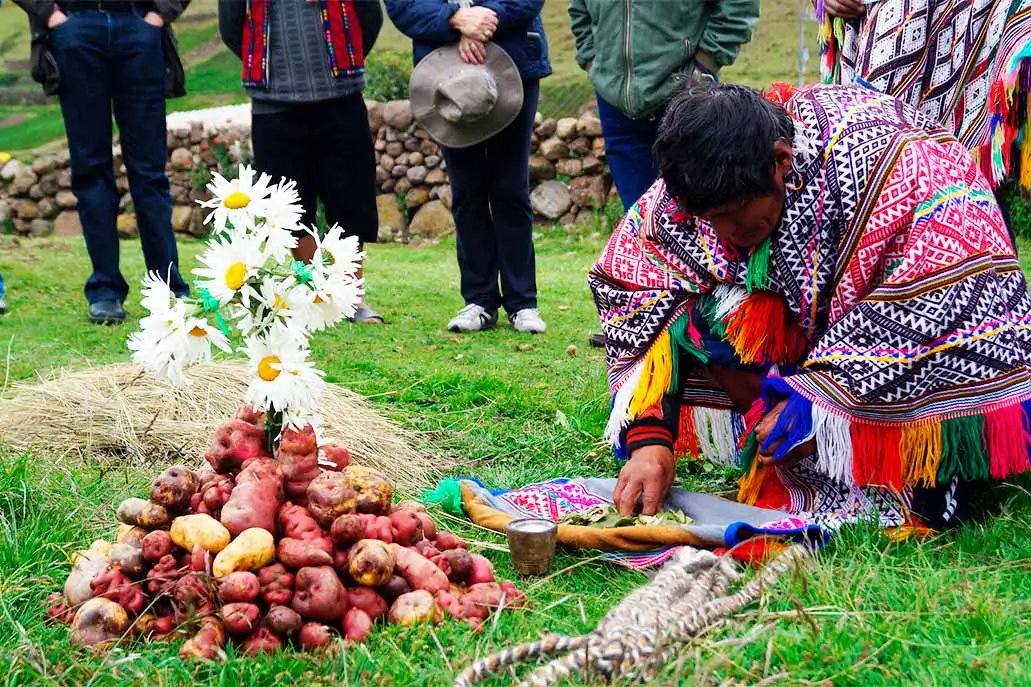
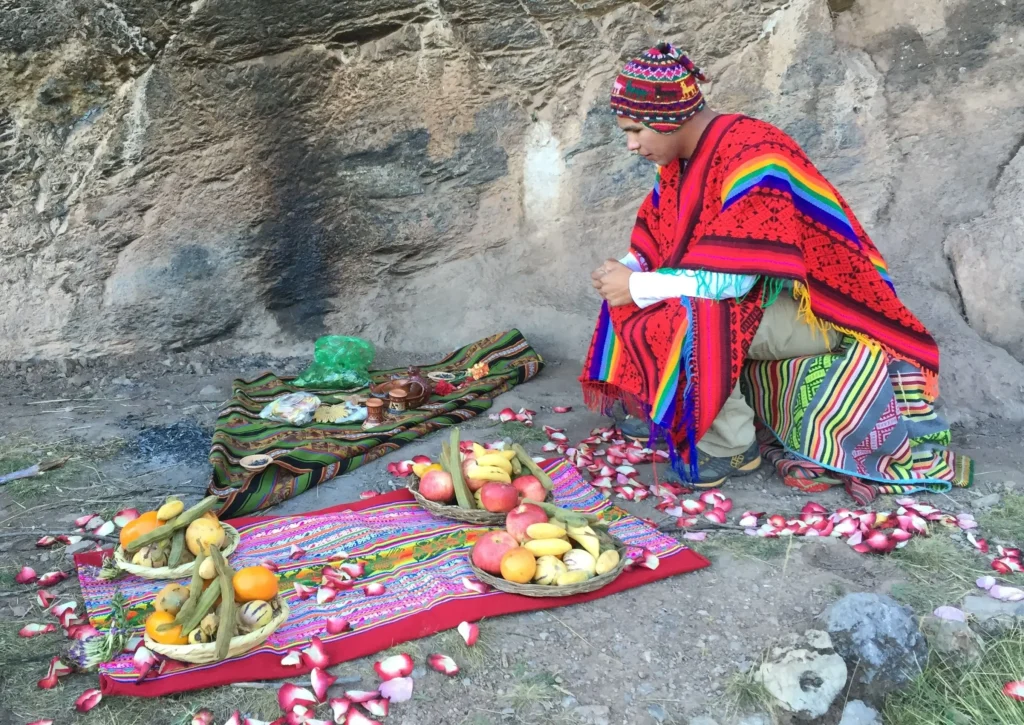
An offering to Pachamama, a despacho or pago, is not a gift in the Western sense of a one-way gesture. It’s a payment inside an ongoing exchange. A typical despacho bundles coca leaves, seeds, small sweets, wool thread and sometimes llama fat into a woven cloth, arranged with specific intention, then burned or buried. Every element has a reason for being there; nothing goes in by default.
Refusing to make an offering before disturbing the earth — breaking ground for a house, opening a new field, crossing a pass — is considered a real risk, not a superstition to be humored. That’s the frame to hold onto: Pachamama isn’t asked to forgive, she’s paid in advance.
Ayni: reciprocity as the organising principle
Ayni means reciprocal labor: you help me build my roof this month, I help you harvest yours next month. No money changes hands and no debt is tracked on paper, because the obligation is understood by everyone involved. It’s the same logic that governs offerings to Pachamama and requests to an apu — nothing is free, and nothing is owed forever without being returned.
Ayni scales beyond individual households. A whole community can perform ayni for a shared project — repairing an irrigation channel, rebuilding a bridge — with labor divided by household and tracked socially rather than administratively. It’s a working economic system as much as a spiritual one, and it’s part of why small Andean communities have kept functioning through centuries with limited cash economies.
How this survives today in Cusco communities
Cosmovision in the Cusco region isn’t a museum practice revived for tourism. Farmers in the Sacred Valley still read weather and soil through it, choosing planting dates around signs read from stars, animal behavior and the condition of specific plants. Coca leaves are still read by a paqo — an Andean ritual specialist — for guidance before major decisions.
Catholic and Andean practice run side by side rather than replacing each other. It’s common to see a cross on a mountain summit next to an apu shrine, or a Pachamama offering made the same week as a church feast day. This blending, sometimes called syncretism, is most visible during festivals such as the Inti Raymi festival, which reconstructs an Inca ceremony to the sun god within a modern civic celebration in Cusco.
Community-level ayni is still active too: agricultural cooperatives, shared water management and mutual construction labor in villages around the Sacred Valley run on the same reciprocity logic described above, adapted to present-day tools and needs.
Where a traveller encounters it on a trip
You don’t need a dedicated spiritual itinerary to run into cosmovision — but a trip built around it goes deeper. On our 14-Day Peru Mystic Tour, it’s structured into the route rather than left to chance: a group ceremony at Tipón on day 11, a limpia (cleansing ceremony) led by a paqo at Quillarumiyoc, and a traditional Pachamanca on day 13 where you take part in the earth-oven preparation itself rather than just eating the result.
Even on a standard Machu Picchu itinerary, you’ll likely see a guide make a small gesture at a pass or an overlook, or hear an explanation of why a particular terrace or stone was oriented toward a specific apu. If you want the fuller picture of what a dedicated route looks like day by day, what happens on a mystic journey breaks down the itinerary in detail.
Respectful participation: what to do and what not to do
Do follow the ritual specialist’s instructions exactly. A despacho or limpia has a specific sequence; improvising isn’t participation, it’s disruption.
Do ask before taking photos during a ceremony. Some moments are fine to record, others aren’t, and the paqo or guide will tell you which is which.
Do treat coca leaves with basic respect if they’re offered to you — they’re used in ritual, not just chewed for altitude relief.
Don’t treat an offering as a performance staged for you. It’s being made to the apu or to Pachamama, and you’re a participant, not an audience.
Don’t assume every guide or vendor selling a “ceremony” is qualified to lead one. A paqo’s role is inherited or trained over years; a five-minute roadside ritual sold to a bus of tourists usually isn’t the real thing.
Don’t remove offerings, stones from shrines, or anything left at an apu site. These aren’t abandoned objects — they’re active.
| World | Animal | Meaning | Where a traveller sees it |
|---|---|---|---|
| Hanan Pacha | Condor | Sky, sun, moon, ancestors reached through height | Condor motifs in Inca stonework; the bird itself over Colca and high passes |
| Kay Pacha | Puma | This world, daily life, strength | Cusco’s original puma-shaped city layout; puma carvings at Sacsayhuamán |
| Uku Pacha | Snake | Underworld, roots, ancestors, the earth’s interior | Serpent carvings on temple walls; ritual openings into caves and underground chambers |
Frequently Asked Questions
What does Pachamama mean? Pachamama means Mother Earth, but in Andean cosmovision she’s understood as an active being owed reciprocity, not a passive symbol of nature. Offerings to her are treated as payments within an ongoing relationship, not one-way gifts.
What is an apu in Peru? An apu is a mountain regarded as a living, conscious protective spirit. Communities near a given apu ask its permission before journeys, harvests or construction, and hold it responsible for the wellbeing of the people living in its shadow.
What is ayni and how does it relate to spirituality? Ayni is reciprocal labor exchange between people or communities, with no money or formal record involved. It’s also the underlying logic of Andean spirituality: offerings to Pachamama and requests to an apu follow the same principle that nothing is given without eventually being returned.
Can travellers take part in an Andean ceremony? Yes, on tours built around it, such as the ceremony at Tipón and the limpia at Quillarumiyoc on our 14-Day Peru Mystic Tour. Participation means following the paqo’s instructions, not directing or altering the ritual.