
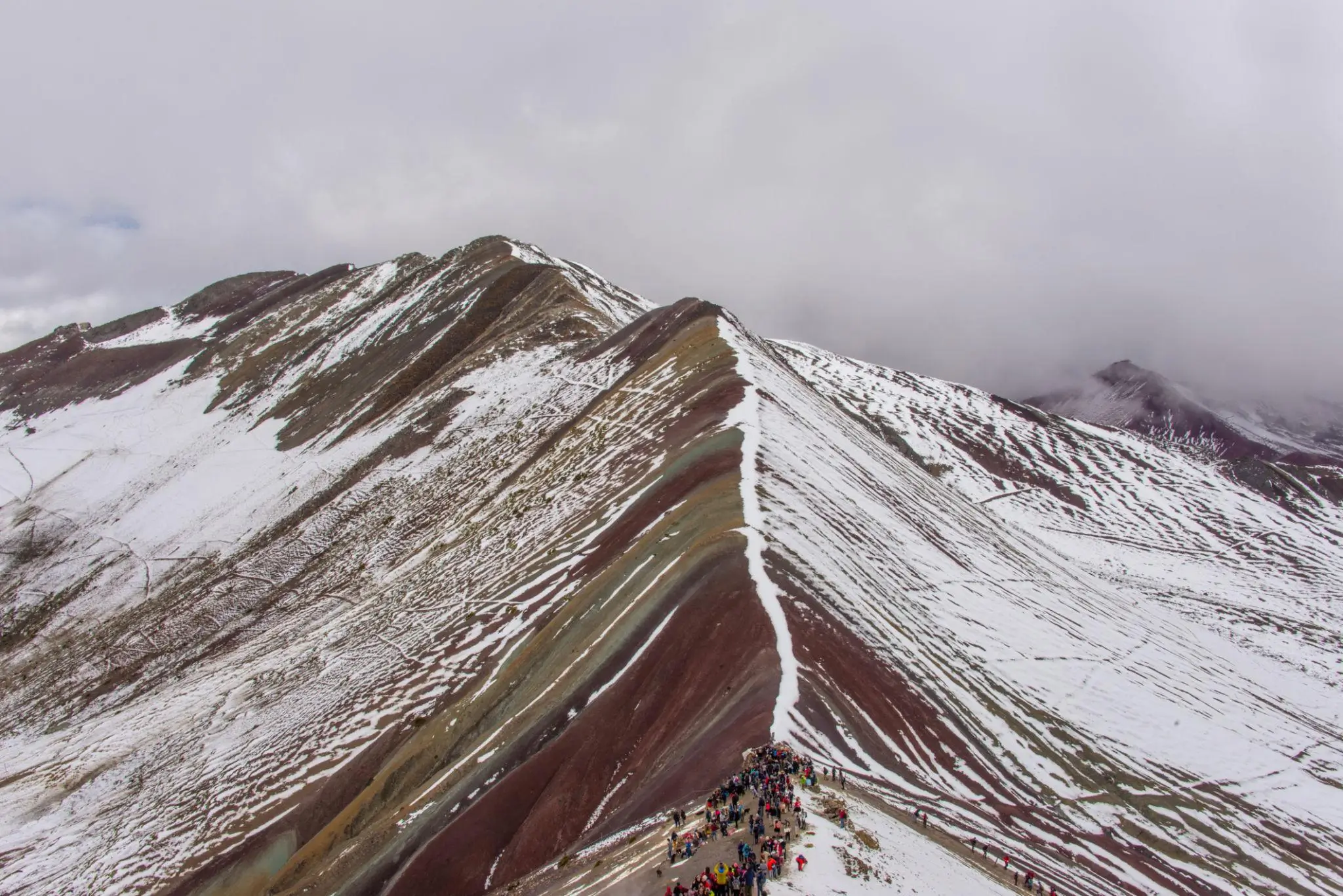
Yes, the colours at Rainbow Mountain are real — but they’re not the neon rainbow you’ve probably seen in an edited photo online. What you’ll find in person is a genuinely striking landscape of layered reds, ochres, lavenders, and greens, formed by different minerals exposed over millions of years, and no, it isn’t photoshopped. The saturation in many viral images simply pushes what’s naturally a more muted, earthy palette. For the full picture of the day, see our complete Rainbow Mountain guide.
The short answer: yes, but not like the photos
This is one of the most common questions people search before booking, and it deserves a straight answer: Vinicunca’s colours are geological, not digital. What varies enormously is how they’re presented online — heavy editing and selective angles create an impression that’s more vivid than what you’ll actually see standing there. That doesn’t make the mountain any less worth visiting; it just means going in with accurate expectations rather than the internet’s most-shared version.
The minerals behind each colour band
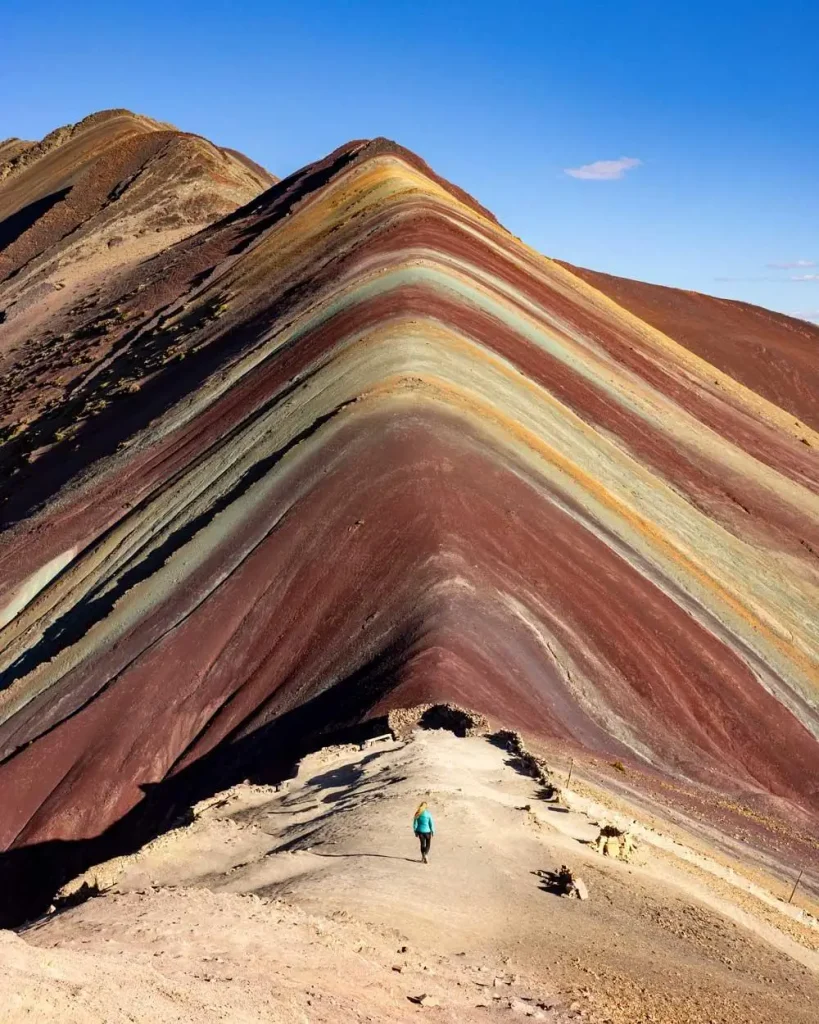
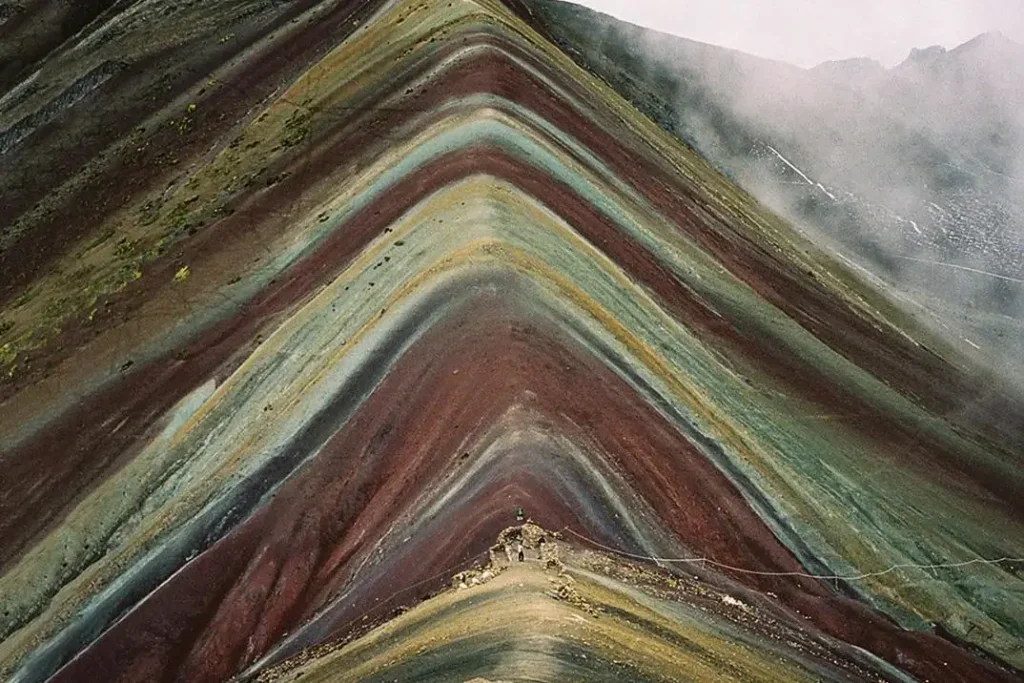
The different colour bands running across the mountain come from different mineral deposits laid down in distinct sedimentary layers over a long geological timeline. Broadly speaking, red and pink tones are associated with iron oxide minerals, similar to what gives rust its colour. Yellows and golds come from minerals containing sulphur, while green bands are linked to minerals containing compounds like copper. The result is a natural striping effect, each band reflecting a different mineral composition laid down at a different point in the region’s geological history.
How the folding of the Andes exposed them
These mineral layers were originally laid down flat, buried under sediment over millions of years. The immense geological forces that pushed up the Andes mountain range folded and tilted these layers, eventually exposing them at an angle on the surface — which is why you see distinct stripes running across the slope rather than a uniform colour. What looks almost artificial is actually the product of slow, ordinary geological processes: sedimentation, mineral deposition, and mountain-building over an enormous span of time.
Why the mountain was only ‘discovered’ recently
Despite the geology being ancient, Vinicunca’s fame is recent. For a long time, snow cover obscured the coloured layers for much of the year, and the area was simply remote high pastureland with little reason for outsiders to visit. Retreating snow cover in recent years exposed the colour bands more consistently, and word — helped enormously by social media — spread fast. The mountain didn’t change; visibility and awareness of it did.
Snow, rain and how the colours change
Weather still affects how the mountain looks on any given day. Snowfall can cover the coloured bands partially or entirely, and rain can darken and mute the tones temporarily. The dry season, roughly April/May to October/November, generally offers the clearest view of the colours with less chance of snow obscuring them, while the wet season, November/December through March/April, brings more unpredictable conditions. If you want more detail on how season affects the shot you’ll actually get, see Rainbow Mountain photography.
| Factor | Effect on the colours |
|---|---|
| Iron oxide minerals | Red and pink bands |
| Sulphur-related minerals | Yellow and gold bands |
| Copper-related minerals | Green bands |
| Snowfall | Can cover bands partially or fully |
| Dry season (Apr/May–Oct/Nov) | Generally clearer view of the colours |
What the colours look like in person
In person, the palette reads as earthy and textured rather than cartoonishly bright — closer to a painted landscape than a filtered photograph. Light plays a real role too: the bands look more defined in the low-angled light of early morning than under the flatter light of midday. Many travellers say the honest, unedited version is still one of the most striking landscapes they’ve seen in Peru, precisely because it’s real rather than digitally enhanced. For a candid take on whether the hike lives up to expectations overall, see is Rainbow Mountain worth it.
Palccoyo: the same geology, gentler access
The same mineral layering that colours Vinicunca is also visible at Palccoyo, a nearby site with a notably easier walk to reach its viewpoints. If the altitude or effort of the main Vinicunca hike concerns you, it’s worth comparing the two directly — see Vinicunca vs Palccoyo for how they differ in access, crowd levels, and the overall experience, while sharing the same underlying geology.
Once you know what to actually expect from the colours, our 1-day Rainbow Mountain tour gets you there at the time of day when the light does the landscape the most justice. And if the region’s geology has you curious about the wider area, the Ausangate massif behind Vinicunca is worth a read too.
FAQs
Are Rainbow Mountain’s colours photoshopped?
No. The colours are real and geological, formed by different mineral deposits. Many widely shared photos are heavily edited to boost saturation well beyond what you’ll see in person.
What causes the different colours at Vinicunca?
Different mineral deposits laid down in layers over millions of years — broadly, iron oxides for reds, sulphur-related minerals for yellows, and copper-related minerals for greens.
Why wasn’t Rainbow Mountain well known until recently?
Snow cover long obscured the colour bands for much of the year, and the area was remote pastureland. As snow retreated and awareness spread through social media, its popularity grew quickly.
Is Palccoyo the same geology as Vinicunca?
Yes, the same type of mineral layering is visible at Palccoyo, with a notably easier walk to the viewpoints than the main Vinicunca trail.