
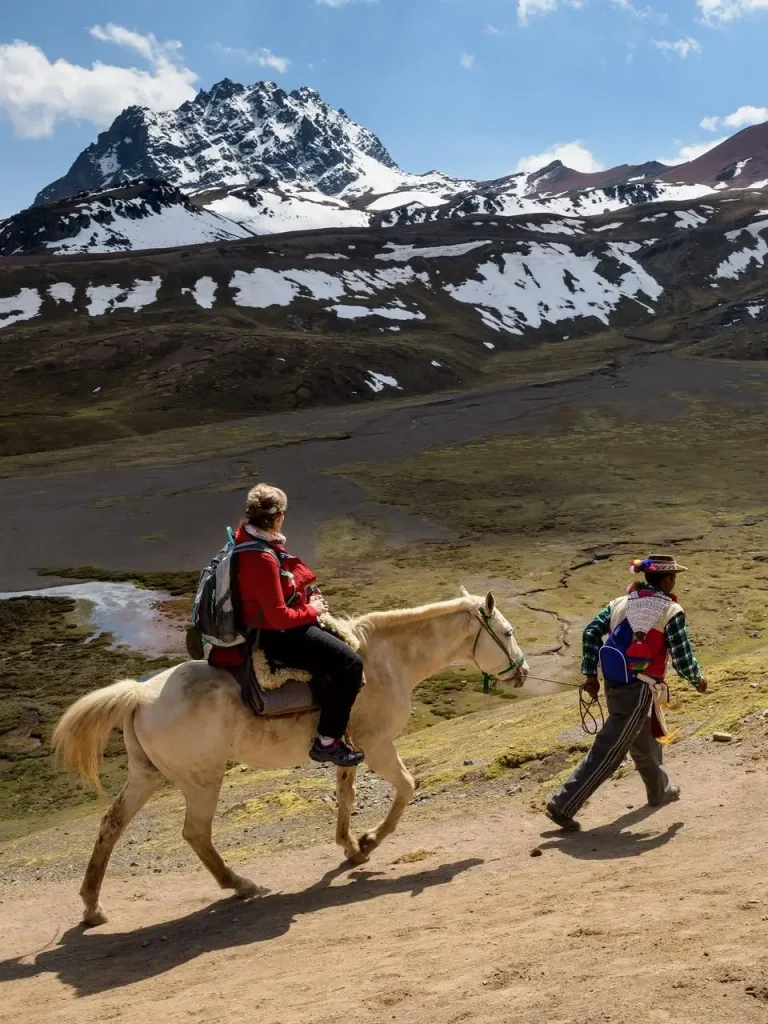
Yes, you can hire a horse for most of the ascent to Vinicunca, but not for all of it. Horses cover the trailhead-to-near-summit stretch — roughly the first 3 to 3.5 km of the hike — and stop before the final, steepest section, which every rider still walks on foot, typically 10 to 15 minutes uphill. Horses are hired on-site from local community handlers, paid in cash, and cost roughly S/60–120 (about $16–32 USD) one way depending on the community and season.
For the full picture of the day, see our complete Rainbow Mountain guide. This article covers just the horse option: where it actually takes you, what it costs, and what to weigh before you decide.
Where you can take a horse and where you cannot
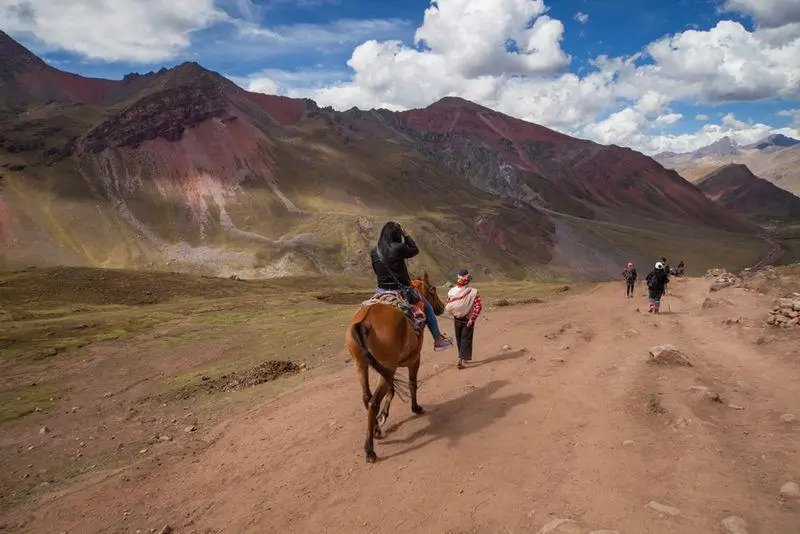
Horses operate on the gentler valley sections of the trail, starting at the trailhead around 4,600–4,630 m. What they cannot do is take you to the actual summit viewpoint at 5,036 m. The animals stop at a fixed point below the final ridge, and from there every visitor — horse or no horse — walks the last stretch on foot.
This matters because it changes what “doing Vinicunca by horse” actually means. You’re not skipping the altitude experience, you’re skipping the longest, flattest, and least dramatic part of the walk, while still facing the hardest section — the steep push near the pass covered in the Vinicunca trail step by step — entirely on your own legs.
The final stretch you must walk regardless
The unavoidable walking section is short in distance — commonly cited at 10 to 15 minutes — but it’s also the steepest and highest part of the entire hike, the same stairs-and-switchback climb that trips up fit hikers who’ve walked the whole trail on foot. Riding a horse for the earlier flat stretch doesn’t reduce the altitude you’re breathing at during this final push; if anything, you arrive at the hardest section having done less to warm up your lungs and legs.
Anyone considering the horse option because they’re worried about altitude, not fitness, should know this upfront: the horse removes distance, not elevation. You still finish the climb to 5,036 m on foot, at the same thin air as everyone else.
Price, who charges it and how to pay
Horse rental isn’t included in most standard Rainbow Mountain tour prices — it’s arranged and paid for separately, in cash, directly to the local family or handler who owns the animal. Reported rates run roughly S/60–120 one way (about $16–32 USD), with round trips costing close to double a one-way fare. Rates vary by community, season, and demand, and there’s no fixed agency price list — each local operator sets its own rate.
Bring small soles. Handlers at the trailhead generally don’t have change for large bills or accept cards, and this is a cash-only, on-the-spot transaction in almost every case.
If you want to see how the horse fee compares to what you’re already paying for entry, entrance fees and community tolls breaks down everything else charged along the way.
Weight limits and who should not ride
There’s a real weight limit, driven by animal welfare and trail safety on steep terrain, generally cited around 75–85 kg (167–190 lbs). This isn’t a strict, universally enforced number — it varies by handler and by animal — but it’s worth knowing before you plan on riding, especially if you’re traveling with a heavier rider in your group.
There’s no fixed age limit reported for the ride itself, but anyone with balance issues, limited riding experience combined with nervousness around animals, or health conditions that altitude alone already complicates should think carefully. The trail isn’t flat the whole way, and a horse doesn’t remove the cardiovascular strain of being at 4,600+ m — it just changes how you cover the ground.
Animal welfare: what to look for
Horses here are owned and operated by local Andean families, not tour agencies, and this work is a meaningful part of household income for these communities. That context matters, but it doesn’t mean every animal on the trail is well cared for on a given day.
What responsible travelers can check for themselves: visible signs of exhaustion or thinness in the animal, whether the handler walks alongside rather than riding a second horse while overloading the client’s mount, and whether the horse is given rest and water at the trailhead between trips. If something feels wrong, you’re free to decline and walk instead — the option always remains.
Booking on the spot vs arranging in advance
For most independent travelers, horse hire happens at the trailhead itself, on the day, with no advance booking required — you simply negotiate with a handler when you arrive. Some tour operators offer pre-arranged horse reservations as part of their service, which removes the on-the-spot negotiation but usually comes at a set price rather than the variable local rate.
Either way, going in with realistic price expectations — and small bills — makes the on-site negotiation faster and less stressful than treating it as a surprise decision.
Is it worth it?
It depends on what you’re trying to solve. If your concern is walking distance and general fatigue rather than altitude tolerance, the horse genuinely helps — it removes roughly 3 km of walking and saves real energy for the steep final stretch and, if you’re doing it, Palccoyo, the easier alternative is worth comparing if walking distance is your main worry rather than a single unavoidable climb.
If your concern is altitude sickness specifically, the horse doesn’t solve that problem — you’re still breathing the same thin air at the same elevation, and you still finish on foot at the highest point of the day. In that case, the better investment is time: extra acclimatization days in Cusco before the tour, not a horse on the trail. Rainbow Mountain: what to expect on the day covers what that acclimatization timeline should look like.
We run our 1-day Rainbow Mountain tour from Cusco with guides who know the trail and can help you make this call on the day, based on how you’re actually feeling at the trailhead rather than deciding in advance from a screen.
| Section | Horse available | Approx. price | Time saved |
|---|---|---|---|
| Trailhead to near-summit | Yes | S/60–120 one way (~$16–32 USD); round trip roughly double | Saves most of the ~3–3.5 km ascent |
| Final stretch to viewpoint | No — walk only | — | None — everyone walks this section |
| Descent | Yes, optional | Similar to ascent rate, arranged separately | Reduces knee strain on the way down |
Frequently Asked Questions
Can I ride a horse all the way to the Rainbow Mountain viewpoint?
No. Horses stop below the final ridge, and every visitor walks the last 10 to 15 minutes to the summit on foot, regardless of whether they rode the earlier section.
How much does a horse to Rainbow Mountain cost?
Roughly S/60–120 (about $16–32 USD) one way, paid in cash directly to the local handler. Round trips cost close to double.
Is there a weight limit for the horse ride?
Yes, generally cited around 75–85 kg (167–190 lbs), for the safety of both rider and animal on steep terrain.
Does the horse help with altitude sickness?
No. The horse reduces walking distance, not the altitude itself. You still reach 5,036 m on foot at the same oxygen levels as everyone else.