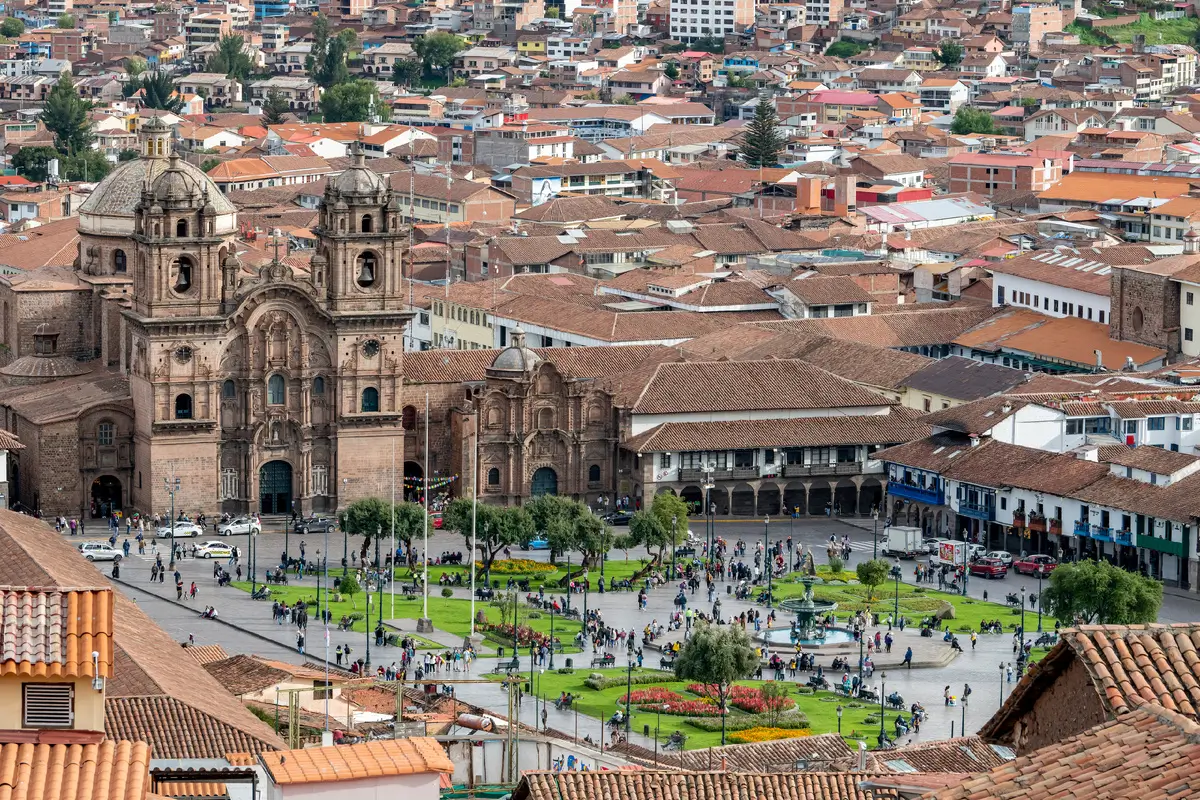
The historic centre around the Plaza de Armas puts you closest to restaurants, tour pickup points, and nightlife, at the cost of noise and higher prices. San Blas, just uphill, trades that convenience for quieter streets, more character, and a genuinely steep walk that matters more than usual given Cusco’s altitude. Areas beyond the centre are quieter and cheaper still, at the cost of a longer walk or taxi ride to where most activity happens. Which one fits depends less on budget than on how your body is likely to handle 3,399 meters in your first two days. For the full range of what a Peru itinerary can include, see our full guide to Peru tour packages.
How Cusco is laid out for a visitor
Cusco’s tourist-relevant area is compact and centred on the Plaza de Armas, the main square, with most of what visitors want to see and do within a 15 to 20 minute walk of it. The historic centre and San Blas both sit within that radius; the difference between them is elevation gain rather than distance, since San Blas climbs the hillside just north of the square.
Beyond that core, the city spreads out into residential districts, including San Sebastián, further from the main square but still within reach by taxi. For most visitors, especially on a first trip focused on Machu Picchu and the Sacred Valley, staying within that central walkable radius makes more sense than saving money on a hotel that requires a taxi for everything.
Cusco itself sits in a bowl-shaped valley, so almost every neighbourhood involves some incline somewhere, this is simply the geography of the city rather than a quirk of any one area. What varies is how steep and how sustained that incline is between your hotel and the places you’ll actually be walking to each day, which is the detail worth paying attention to rather than the flat statement that a neighbourhood is “hilly.”
Centro histórico: convenience and noise
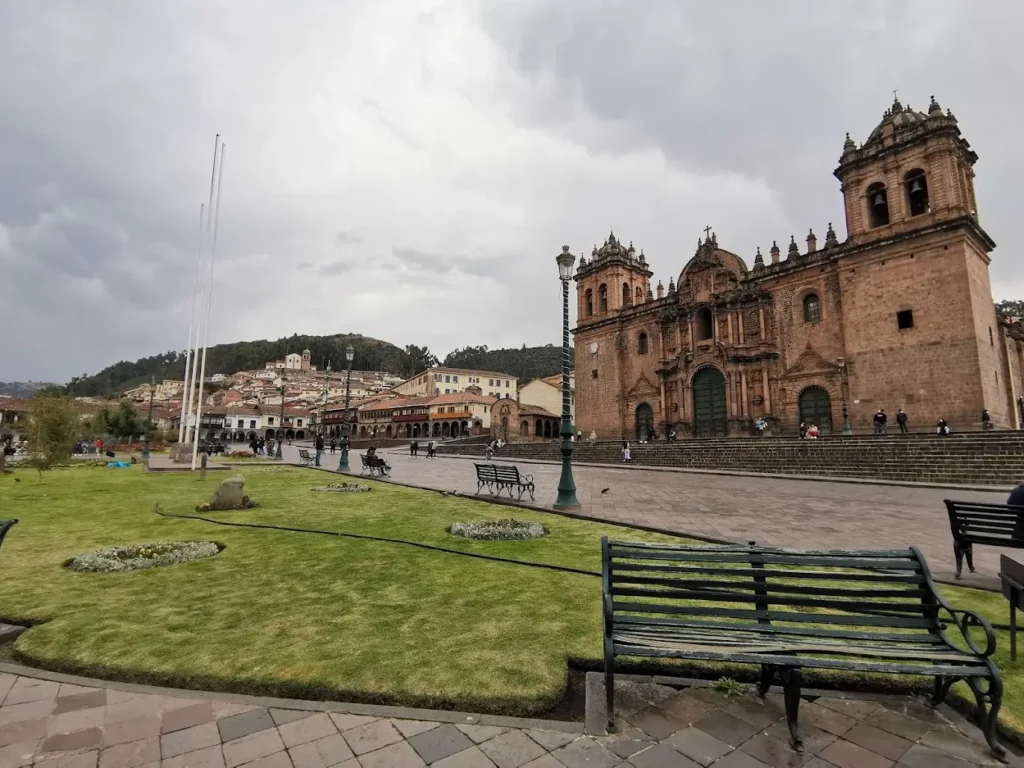
The historic centre, the streets immediately around the Plaza de Armas, is where most restaurants, tour operator offices, and pickup points are concentrated. Staying here means walking to dinner, walking to your morning tour departure, and generally not needing transport for day-to-day logistics.
The trade-off is noise and price. This is the busiest part of the city at almost any hour, with bars, restaurants, and street activity running later than in quieter neighbourhoods, and hotel rates here tend to run higher than elsewhere in the city for a comparable room. A room facing directly onto a busy street or a nightlife-heavy block can mean noise well into the evening, so if you’re sensitive to that, ask specifically about a quieter interior room rather than assuming central automatically means noisy everywhere.
This area also makes the most sense logistically if your itinerary has an early pickup. A tour departing at 6 or 7 in the morning is far less of a burden when your hotel is a five-minute walk from the meeting point than when it requires a taxi across town while you’re still adjusting to the altitude. If your priority is minimizing logistics and maximizing walkability, this is the area to choose; if you want quiet evenings, it is worth looking elsewhere.

San Blas: charm and stairs at altitude
San Blas is Cusco’s hillside artisan neighbourhood, known for narrow cobblestone streets, a concentration of galleries and craft shops, and a quieter, more residential feel than the main square just below it. It is a genuinely appealing place to stay, and it comes with one detail that matters more here than it would anywhere else: the streets are steep, in some stretches closer to stairs than a gentle incline.
This matters specifically because of when most visitors arrive. If you are staying in San Blas during your first day or two in Cusco, before you have acclimatized to 3,399 meters, that walk up to your hotel can be genuinely taxing in a way it would not be at sea level. Carrying your own luggage up those same stairs, rather than having it handled for you, adds to that on arrival day specifically.
San Blas is also home to a small plaza of its own, a concentration of artisan workshops, and some of the better viewpoints over the city’s rooftops, which is a large part of its appeal once you’re not thinking about the climb. It is not a reason to avoid the neighbourhood, but it is a reason to know what you are choosing: charm and character during the days you are already adjusted, at the cost of a harder walk during the days you are not.
Beyond the centre: quieter and cheaper
Neighbourhoods further from the Plaza de Armas, including areas like San Sebastián, offer a quieter, more residential experience and generally lower hotel rates than the historic centre or San Blas. These areas function more like ordinary neighbourhoods where locals actually live, which some travellers prefer over a hotel surrounded entirely by other visitors, and it’s a reasonable trade if a more local feel matters to you as much as saving money does. The trade-off is straightforward: more distance to cover for restaurants, tour pickups, and evening activity, usually by taxi rather than on foot.
| Area | Distance from Plaza de Armas | Character | Price tendency |
|---|---|---|---|
| Centro histórico | At the centre | Busy, walkable, tourist-focused | Higher |
| San Blas | Short uphill walk | Quiet, artisan, steep streets | Mid to higher |
| Beyond the centre (San Sebastián and similar) | Requires taxi for most activity | Residential, quieter | Lower |
This option suits travellers prioritizing budget or quiet over walkability, particularly if you are comfortable arranging taxis for restaurants and pickups rather than walking to them. It’s also worth considering if you’re staying in Cusco for several nights rather than passing through quickly, since the savings on a longer stay add up more than they would over one or two nights, and you have more time to learn the taxi routes and settle into a quieter routine away from the tourist core.
The altitude factor when choosing a hotel
Every part of Cusco sits at essentially the same elevation, 3,399 meters, so the altitude itself is not a reason to choose one neighbourhood over another. What does vary between neighbourhoods is how much physical exertion getting to your hotel involves, and that is where San Blas’s stairs become a genuine factor rather than a minor detail.
The general rule for the first 48 hours at altitude is to keep exertion low: short walks, no rushing, plenty of water. A hotel that requires a steep uphill walk with luggage works against that rule on your arrival day specifically, even if it is a perfectly comfortable neighbourhood once you have adjusted. If you know you’ll be arriving with heavy bags and want to minimize exertion on day one, the flatter streets of the historic centre or an area beyond it with vehicle access right to the door are the more forgiving choice; save San Blas for a booking that starts a few days into your trip, once you’ve had time to adjust, or accept the climb as a one-time cost on arrival day and plan a slow, unhurried walk up rather than rushing it. Your first 48 hours in Cusco covers the acclimatization routine itself in more depth, and it is worth reading before you commit to a hotel location, not just before you land.
What hotel category comes with a tour package
Our packages use 3-star hotels as standard, or a mix of 3 and 4-star depending on the specific itinerary, with upgrades to 4 or 5-star available on request. We do not name specific properties here, since the hotel used for any given departure depends on availability and the itinerary itself, but the category gives you a reliable expectation of comfort level to plan around: a private bathroom, heating or extra blankets given Cusco’s cold nights, and breakfast included are standard at this level, with the main differences between 3 and 4-star properties usually coming down to room size and finish rather than anything functional.
If you are choosing between our 6-day Cusco and Machu Picchu tour and the 7-day Cusco and Machu Picchu tour, the hotel category itself does not change meaningfully between them; the extra day buys you more time in the itinerary, not a different tier of accommodation. What does come standard across our packages is airport and hotel transfer, so wherever your hotel falls within Cusco, getting to and from it on arrival and departure days is already arranged rather than something you need to negotiate with a taxi driver while still adjusting to the altitude. If a specific comfort level matters more to your trip than the extra day does, luxury vs mid-range packages is the better comparison to read, since that is where the accommodation tier itself is the variable. What a Peru package includes covers the full list of what comes bundled alongside your hotel, including transport and guiding.
When to consider a night in the Sacred Valley instead
Not every itinerary needs every night spent in Cusco itself. The Sacred Valley sits at a somewhat lower elevation, around 2,800 meters compared to Cusco’s 3,399, and a night there partway through your trip can work as a gentler stop between arrival and a demanding day like Machu Picchu or Rainbow Mountain.
This is less about avoiding Cusco altogether and more about sequencing: arriving in Cusco, spending your first acclimatization days there, then moving to the Sacred Valley ahead of your Machu Picchu day, rather than doing everything from a single Cusco base. It adds a small amount of logistics, packing and repacking partway through the trip, in exchange for a slightly easier few hundred meters of altitude on the nights that matter most for rest.
This is worth weighing specifically if you struggled with the initial adjustment to 3,399 meters, or if your itinerary includes a demanding day like Rainbow Mountain close to your Machu Picchu visit and you want a genuine change of pace between the two rather than two consecutive early starts from the same hotel. Once you’re back in Cusco or heading to Machu Picchu itself, where to stay in Aguas Calientes covers the town at the base of Machu Picchu, which is its own separate decision from anything covered here.
Frequently Asked Questions
What is the best area to stay in Cusco? The historic centre around the Plaza de Armas is the most convenient for walkability, restaurants, and tour pickups. San Blas offers more character and quiet at the cost of steep streets, and areas further out are cheaper but require taxis for most activity.
Is San Blas a good place to stay in Cusco? Yes, especially for its character and quieter streets, but its steep, stair-like streets are worth factoring in for your first day or two, before you have acclimatized to Cusco’s altitude.
Does hotel location in Cusco affect altitude sickness? Not directly, since all of Cusco sits at roughly the same elevation. What matters more is how much physical exertion, like a steep uphill walk with luggage, getting to your hotel involves during your first days before acclimatizing.
What hotel category do Peru Andes Discovery tours use in Cusco? Our standard packages use 3-star hotels, or a mix of 3 and 4-star depending on the itinerary, with upgrades to 4 or 5-star available on request.
Can I stay in a different neighbourhood for part of my Cusco trip? Yes, this is a reasonable approach if you want the historic centre’s convenience for an early-departure day and San Blas’s quieter streets for a slower day later in your trip, once you’ve adjusted to the altitude.