
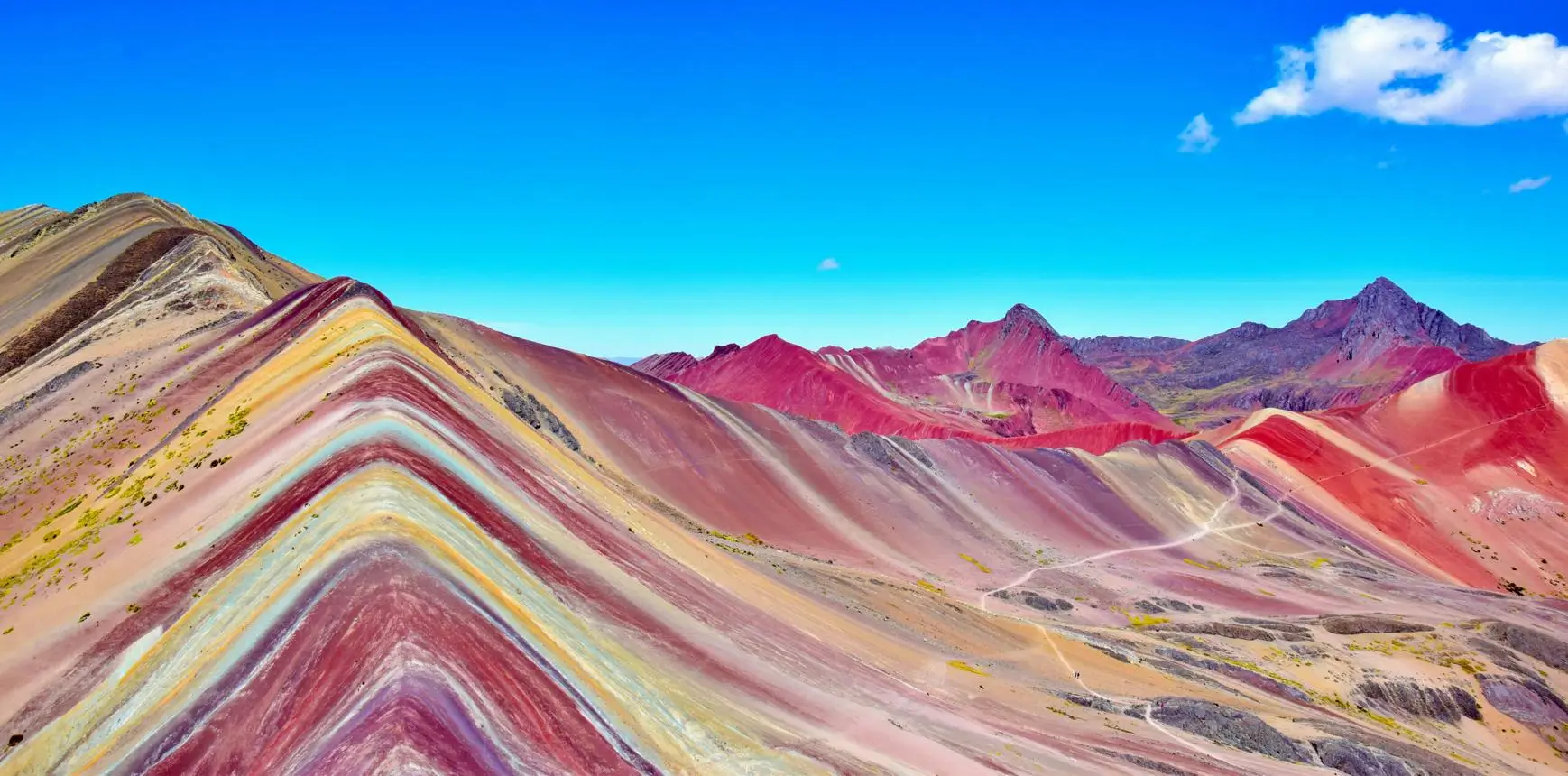
Red Valley (Valle Rojo) is a second colored landscape a 30 to 60-minute walk beyond the main Vinicunca viewpoint, sitting at roughly 5,050 m / 16,568 ft — slightly higher than Rainbow Mountain itself. It’s not a separate trip. It’s an extension of the same hike, on the same access road, past the same community checkpoints. Most day tours stop at Vinicunca and turn around. Below, we break down what it costs, what it adds, and whether it’s worth the extra push at altitude. For the full logistics of the main hike, see our complete Rainbow Mountain guide.
What Red Valley is and where it sits relative to Vinicunca
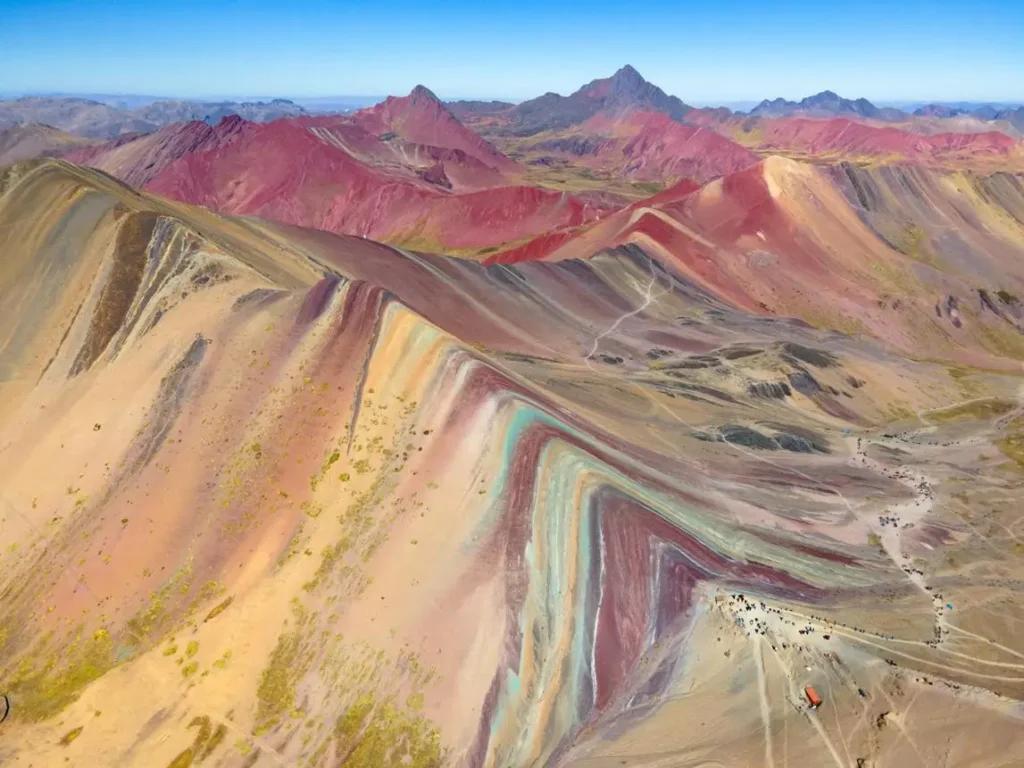
Red Valley is a stretch of iron-rich slopes on the far side of the ridge from Vinicunca’s striped mountain face. Where Vinicunca shows its color on one steep flank, Red Valley opens into a wide basin — rust, ochre, and deep red hillsides rolling toward the Ausangate range in the distance. Both sites sit above 5,000 m, both are reached from the same trailhead near Pitumarca, and both are part of the same community-managed access system.
The connecting trail runs along the ridge past the Vinicunca viewpoint, adding roughly 2 to 4 km round trip depending on whether you loop back through the valley or retrace your steps. It’s not a detour to a different mountain. It’s the next 30 to 60 minutes of the same trail, at the same altitude band, with a different view at the end of it.
If you haven’t hiked the main route yet, the Vinicunca trail step by step covers the ascent itself — Red Valley picks up exactly where that trail leaves the main viewpoint.
Why most tours do not include it
Three reasons, and none of them are about the view. First, time: a standard Rainbow Mountain itinerary is already a long day — early pickup, a multi-hour drive, and a hike at extreme altitude before the drive back to Cusco. Adding 60 to 90 minutes at 5,000 m pushes the whole schedule later, which matters when afternoon weather in the Andes turns fast.
Second, group pacing. Large group tours move at the speed of the slowest hiker. If even a few people in a 15 to 20-person group are struggling with the altitude at Vinicunca, the operator has no room to add an extension without risking the return drive.
Third, most travelers don’t ask. Vinicunca is the name people search for and the image they’ve seen online. Red Valley barely shows up in trip research, so operators build default itineraries around the one stop everyone expects and treat the second one as optional, if it’s offered at all.
Extra time, extra fee, extra effort
Going to Red Valley is never free in time or effort, even if the walk itself is short. You’ve already climbed to just above 5,000 m to reach Vinicunca. The extension keeps you at that altitude, or slightly higher, for another 30 to 60 minutes each way, on legs that are already tired from the first climb.
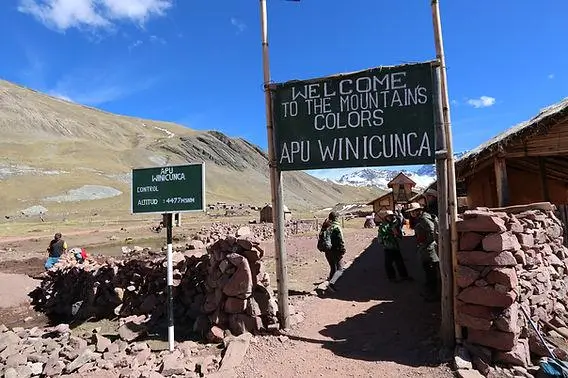
There’s also a separate community fee. Red Valley sits on land managed by a different local community than the main Vinicunca checkpoint, and that community collects its own entrance charge, paid in cash, on top of what you’ve already paid to reach Rainbow Mountain. For the full breakdown of what you pay and where, see entrance fees and community tolls.
Here’s how the two options compare side by side:
| Vinicunca only | Vinicunca + Red Valley | |
|---|---|---|
| Extra time | — | +60–90 min round trip |
| Extra cost | — | — |
| Extra effort | — | 2–4 km more, at or above 5,000 m, on already-tired legs |
| What you gain | The classic striped viewpoint | A quieter, wider red landscape with Ausangate views, fewer crowds |
What it looks like compared to Vinicunca
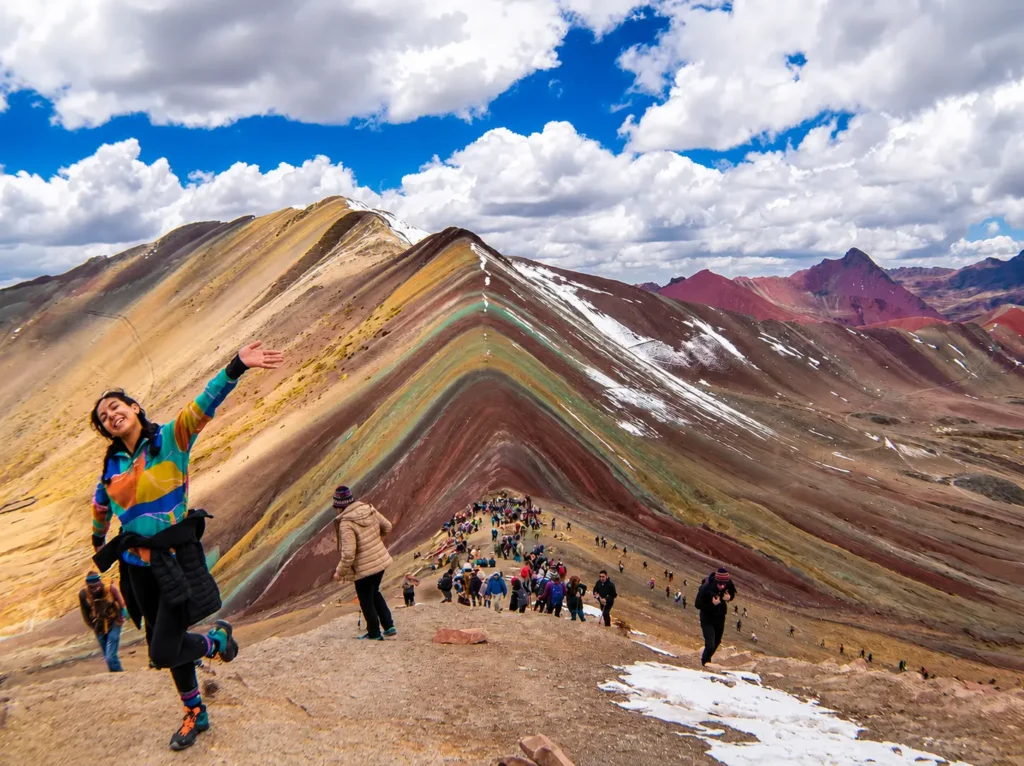
Vinicunca is a single mountain face with visible color bands — pink, gold, rust, and lavender running across the slope in stripes. It’s the postcard image, and it’s why almost everyone books this trek in the first place. The viewpoint is a defined spot, usually crowded, with a clear best angle for photos.
Red Valley is different in shape and mood. Instead of one striped face, you’re looking at an open basin of red and rust-colored hillsides, more uniform in tone but larger in scale. There’s no single “money shot” angle the way there is at Vinicunca — the whole landscape reads as color. Because far fewer visitors make the extra push, you’ll often have long stretches of the ridge to yourself, with the Ausangate range visible on clear days.
If your goal is the iconic striped photo, Vinicunca delivers that on its own. If you want a landscape that feels more remote and less photographed, Red Valley is the one that does that. Some travelers weighing both options against a third alternative also compare Vinicunca vs Palccoyo, which trades altitude for a gentler, three-color hike.
Best season for the colour
Dry season, roughly May through September, is when both Vinicunca and Red Valley show their strongest color and the clearest skies. Less rain means less mud on the trail and better visibility toward Ausangate from the ridge.
Shoulder months (April and October) can still deliver good conditions, but weather is less predictable — pack layers regardless of the forecast. Wind picks up noticeably at this altitude in the shoulder season, which matters more on the Red Valley extension since you’re exposed on an open ridge for longer than the short Vinicunca viewpoint stop.
Rainy season (November through March) brings a real risk of afternoon lightning at this elevation, given the high mineral content in the soil. Local guides generally avoid pushing groups to Red Valley late in the day during these months, regardless of how the morning looked.
Is it worth it? Our honest take
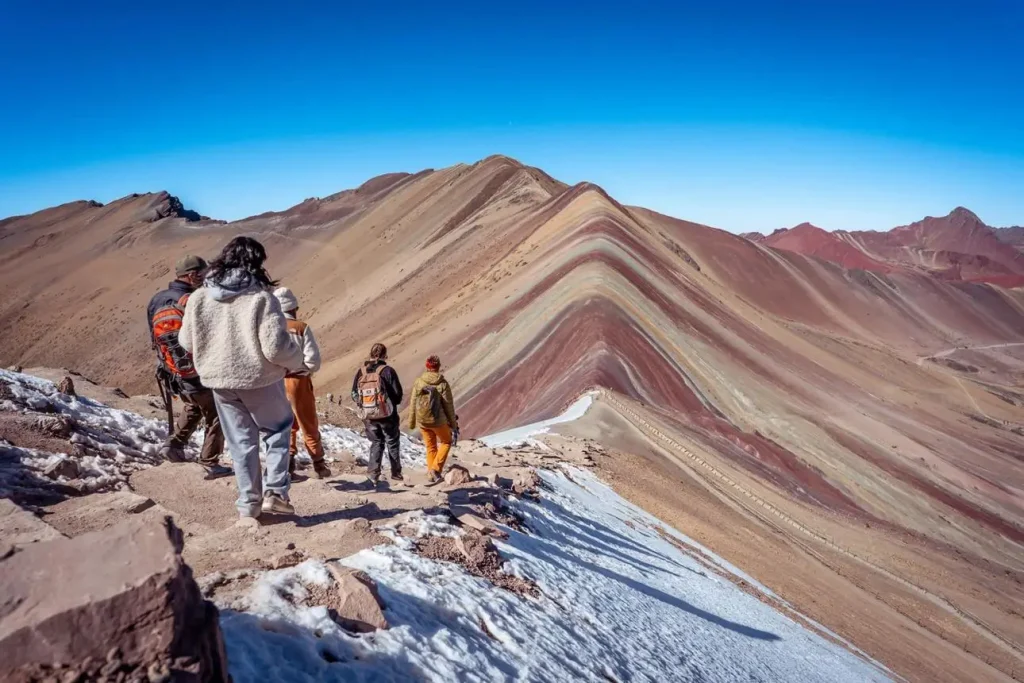
If you’re already acclimatized and moving comfortably at 5,000 m, yes. The extension adds real value: a different landscape, fewer people, and views toward Ausangate you don’t get from the main viewpoint. It’s not a second attraction bolted on for marketing — it’s a natural continuation of a trail you’ve already climbed.
If you’re struggling with the altitude at Vinicunca — headache, nausea, or genuinely labored breathing — skip it. Pushing another 60 to 90 minutes higher when your body is already signaling distress isn’t worth a better photo. Our guides make that call on the day based on how each group is actually doing, not on the itinerary printed the night before.
Whatever the current policy, the honest version of “is it worth it” depends more on how your body is handling the altitude that morning than on the extra kilometers.
Ready to plan the day itself? Start with our 1-day Rainbow Mountain tour and decide on the extension once you know your acclimatization schedule.
How to make sure your tour includes it
Ask before you book, not on the trail. Confirm three things directly with whichever agency you’re considering: whether Red Valley is included by default or offered as an add-on, whether the community fee is bundled into the tour price or paid separately in cash, and whether the itinerary builds in enough time for the extension without rushing the return drive.
Group size matters here more than most people realize. A smaller group can adjust pace on the day — if everyone’s doing well at the Vinicunca viewpoint, the guide can extend to Red Valley on the spot. A large group locked into a fixed schedule usually can’t.
If Red Valley matters to you, say so when you book, and confirm it again the morning of the hike. Weather and group pacing can change the plan even when the extension is standard. For a full walkthrough of what the day actually looks like from pickup to return, read Rainbow Mountain: what to expect on the day before you go.
We build the acclimatization schedule and the Red Valley call into every departure of our 1-day Rainbow Mountain tour — ask us about it when you book.
Frequently Asked Questions
Is Red Valley included in every Rainbow Mountain tour?
No. Most standard group itineraries stop at the Vinicunca viewpoint and turn back. Red Valley is typically offered as an extension, either built into specific itineraries or available on request depending on the operator, group size, and conditions on the day.
How much extra walking does Red Valley add?
Expect roughly 30 to 60 minutes each way beyond the main Vinicunca viewpoint, adding about 2 to 4 km round trip depending on the exact route taken.
Is there a separate entrance fee for Red Valley?
Yes. Red Valley sits on land managed by a different local community than the main Vinicunca checkpoint, so it has its own entrance charge, paid separately in cash.
Is Red Valley harder than Vinicunca?
It’s not technically harder — there’s no climbing involved — but it keeps you at or above 5,000 m for longer, on legs already tired from the main ascent. The main challenge is cumulative altitude exposure, not the terrain itself.