

Rainbow Mountain isn’t a day to improvise once you land in Cusco — sequencing matters, both for how your body handles the altitude and for how the rest of your trip flows around it. Built into a longer itinerary, with proper acclimatization before it and a lighter day after, it works far better than an early add-on decided on the fly. For the full picture of the hike itself, see our complete Rainbow Mountain guide.
Rainbow Mountain is not a day you improvise
At 5,036 m, Rainbow Mountain asks more of your body than almost anything else on a standard Peru trip. Slotting it in wherever there happens to be a free day, without regard to how the rest of your itinerary is structured, is how people end up having a genuinely miserable time. Treating it as a day that needs proper placement — like Machu Picchu, not like a casual half-day stroll — pays off in how you actually feel on the trail.
Where it fits in a 6, 7 or 8-day itinerary
On a longer trip, Rainbow Mountain works best once you’ve had several days to settle into Cusco’s altitude and, ideally, after any acclimatization outings you’ve built in. The 6-day Cusco and Machu Picchu tour and the 8-day Cusco and Machu Picchu tour both give you more time to build this in properly than a short 2 or 4-day trip would, with private transport and, on these longer packages, a private guide throughout. The exact placement of Rainbow Mountain within your specific itinerary is worth confirming when you book, since it depends on how the rest of your days are structured.
Why it should never be day one or day two
Landing in Cusco and heading to Rainbow Mountain within the first day or two is asking for trouble. Your body needs time just to adjust to Cusco’s own 3,399 m before adding another 1,600 m on top of it. See acclimatization before Rainbow Mountain for a realistic timeline of how those early days should look — the short version is: rest first, then build up gradually.
What to schedule the day after
Rainbow Mountain is physically demanding, and most travellers are genuinely tired the following day. Scheduling something low-key afterwards — a free morning, a gentle walk, or simply a slower pace in Cusco — gives your body a chance to recover rather than stacking another demanding activity right on top of it. This is one of the advantages of a longer, well-built itinerary over trying to cram everything into the fewest possible days.
| Itinerary length | How Rainbow Mountain fits |
|---|---|
| 6-day Cusco & Machu Picchu | Placed after initial acclimatization days |
| 8-day Cusco & Machu Picchu | More flexibility to space it from Machu Picchu |
| Day after Rainbow Mountain | Best kept light — recovery, not another big day |
Machu Picchu first or Rainbow Mountain first
There’s no universal right answer here, but a few principles help. Machu Picchu, at 2,430 m, is lower than Cusco and generally easier on the body than Rainbow Mountain’s 5,036 m, so some travellers prefer to do Rainbow Mountain first while they’re fully rested, then treat Machu Picchu as the lower-effort second half of the trip. Others prefer the reverse. What matters more than the specific order is not scheduling either one immediately after the other with no recovery day between — see Rainbow Mountain vs a Sacred Valley day trip if you’re weighing what else could sit between them.
Building it into a package vs booking it separately
Booking Rainbow Mountain as part of a structured multi-day package means the sequencing, acclimatization days, and transport are already handled as part of the itinerary, rather than something you have to plan around yourself. It also means private transport and, on our 6, 7 and 8-day packages, a private guide throughout — a different experience from booking a standalone day tour and hoping the timing works out with whatever else you’ve arranged independently.
A sample week that works
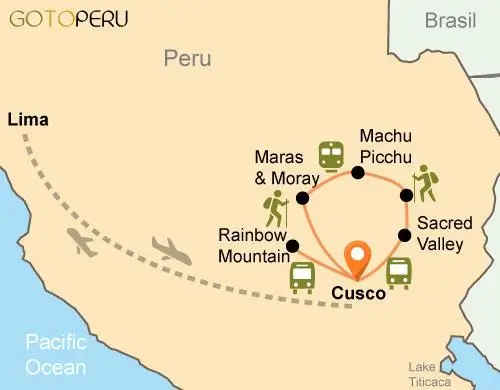
A reasonable shape for a week built around both Rainbow Mountain and Machu Picchu looks like this: arrival and rest in Cusco, a couple of days settling into the altitude with lighter activities, Rainbow Mountain once you’re acclimatized, a lighter recovery day, then the Machu Picchu leg of the trip via Ollantaytambo and the train. For guidance on how many days a trip like this really needs overall, see how many days you need in Peru, and for what those first days in the city should actually involve, your first 48 hours in Cusco is worth reading before you finalize your dates.
If you’re ready to build a trip that includes Rainbow Mountain properly sequenced alongside Machu Picchu, the 6-day Cusco and Machu Picchu tour and the 8-day Cusco and Machu Picchu tour are both worth a look — get in touch and we’ll help you place Rainbow Mountain where it fits best in your specific itinerary.
FAQs
Where should Rainbow Mountain go in a Peru itinerary?
After a few days of acclimatizing to Cusco’s altitude, never on your first or second day, and ideally followed by a lighter recovery day rather than another demanding activity.
Should I do Rainbow Mountain before or after Machu Picchu?
There’s no universal answer — some travellers prefer Rainbow Mountain first while fully rested, others the reverse. What matters most is not scheduling them back to back with no recovery day between.
Is it better to book Rainbow Mountain as part of a package or separately?
Booking it within a structured multi-day itinerary means acclimatization days and transport are already planned around it, rather than something you have to coordinate yourself.
How many days do I need for a trip that includes both Rainbow Mountain and Machu Picchu?
A 6 to 8-day itinerary generally gives enough room to acclimatize properly, fit in both experiences, and include recovery time between demanding days.