
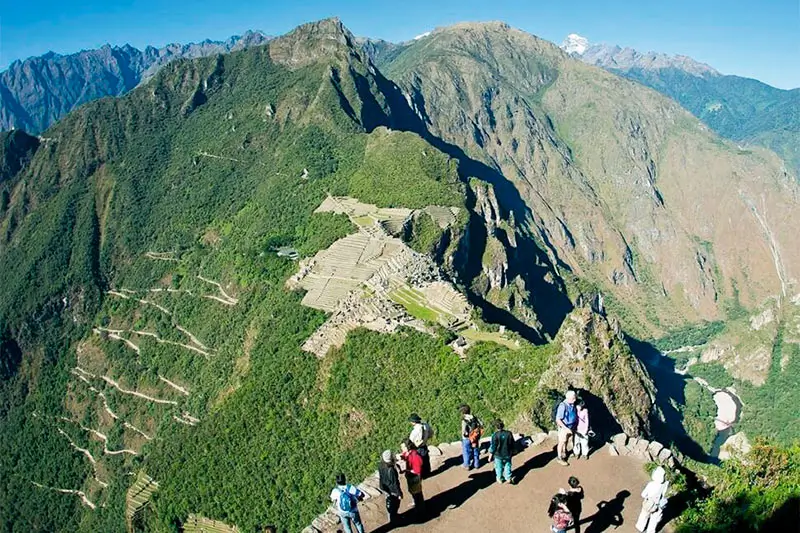
Huayna Picchu is the steep, forested peak behind Machu Picchu in every classic photo. It reaches 2,693 m (8,835 ft), about 260 m (850 ft) above the citadel itself. The climb takes roughly 1.5 hours up and 1 hour down, on narrow stone stairs with sections of real exposure. Only 400 permits are issued per day, split into two entry groups, and they sell out 2–4 months in advance. If your dates fall between June and August, book at least 3 months ahead. This is not a walk you add on-site — the ticket has to be bought alongside your Machu Picchu entrance ticket, months before you fly.
If you’re still deciding whether Machu Picchu itself is the right circuit and route for your trip, our complete Machu Picchu guide covers the full picture. This article is just about the mountain: what the climb actually feels like, who shouldn’t do it, and what you get at the top.
We book Huayna Picchu permits for clients constantly, and we also turn people away from it — politely, but firmly — when it’s clearly the wrong hike for them. Here’s the honest version.
What Huayna Picchu is and how high it goes
Huayna Picchu — sometimes spelled Wayna Picchu — means “young mountain” in Quechua, distinguishing it from Machu Picchu, “old mountain.” It rises directly behind the citadel on its northern side, and it’s the peak you see in almost every wide photo of the site.
The summit sits at 2,693 m (8,835 ft) above sea level. Machu Picchu itself sits at 2,430 m (7,972 ft), so the climb gains about 260 m (850 ft) in a short distance — under 1 km of trail each way. That gain is compressed into a steep, direct route, which is why the climb feels harder than the number suggests.
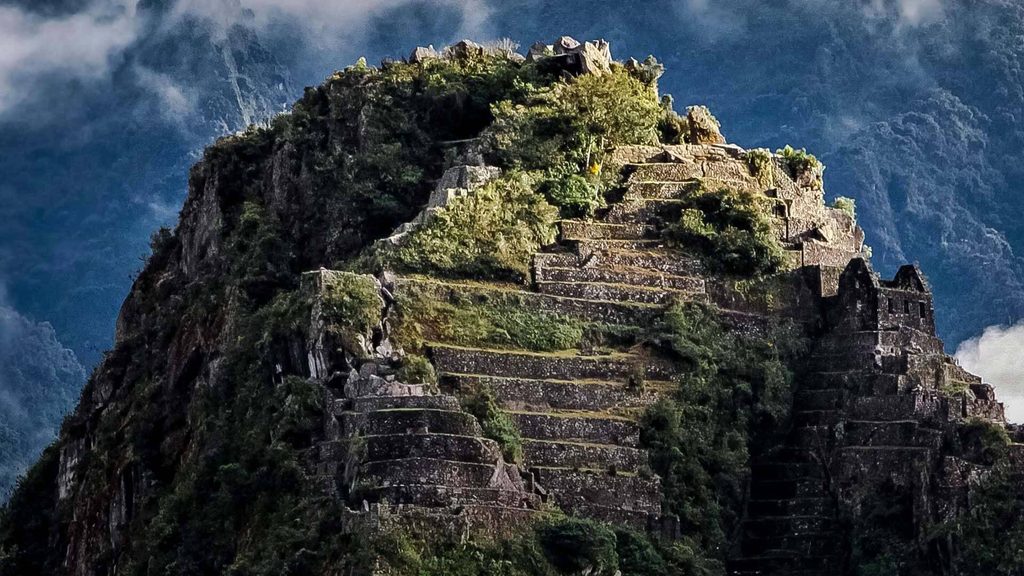
At the top, Inca terraces and small structures remain, including what’s believed to have been a residence and lookout post. The Incas built the entire trail by hand, cutting stairs directly into the rock face in sections.
The climb: stairs, exposure and real times
Budget 1.5 hours for the ascent and 1 hour for the descent — that’s what our guides see consistently with clients of average fitness, not including time spent at the summit. The trail is almost entirely stone steps, many of them narrow, uneven, and set at a steep angle.
The most talked-about section is the so-called “Stairs of Death” — a steep, narrow staircase near the summit with a fixed cable to hold onto. It’s not technical climbing, but it does require using your hands, and there’s real exposure on both sides in places.
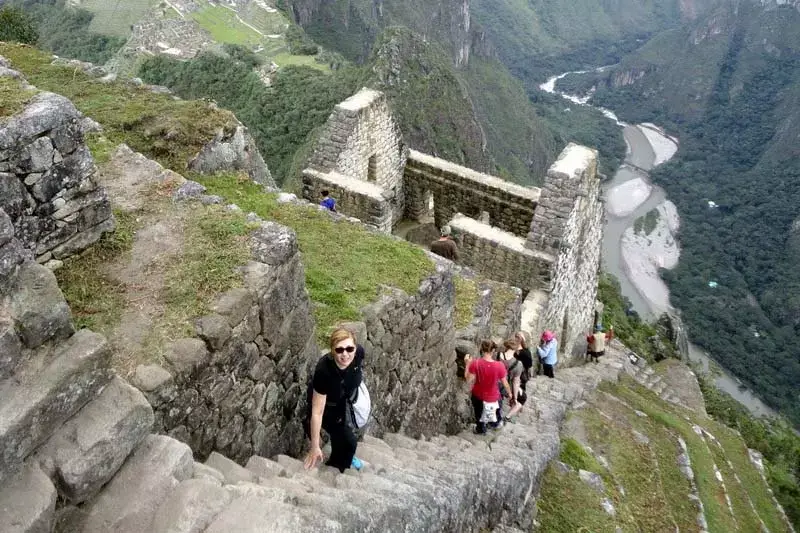
The trail is one-directional in the sense that passing other hikers on narrow sections requires patience — you’ll wait at times for people coming down before you can continue up. Factor that into your schedule; don’t assume the trail time is a straight walking pace with no stops.
Honest difficulty: who should not attempt it
We’d rather lose the sale than send someone up who shouldn’t be there. Based on what our guides see on the mountain regularly, Huayna Picchu is a poor fit if:
- You have a real fear of heights. This isn’t a mild scenic overlook — there are sustained drop-offs next to the trail, and no amount of talking yourself into it in advance changes how your body reacts at the moment.
- You have knee or ankle problems. The descent is harder on joints than the climb up, and the uneven stone steps don’t forgive an unstable ankle.
- You’re traveling with young children. The narrow sections and cable-assisted stairs aren’t manageable with a small child, even one who’s a confident walker on flat ground.
- You haven’t acclimatized. You don’t need to be a mountaineer, but arriving straight from sea level with no time in Cusco or the Sacred Valley first makes any physical exertion harder at this elevation.
If any of that describes you, Huchuy Picchu or the base Machu Picchu circuits give you strong views without the exposure. We cover the full comparison in Huayna Picchu vs Machu Picchu Mountain.
Tickets: daily caps, time slots, how far ahead to book
Huayna Picchu access is capped at 400 people per day, divided into two entry groups. The two groups are scheduled at set morning times, and you’re locked into whichever one your ticket specifies; you can’t switch on arrival.
These permits sell out 2 to 4 months in advance during regular season. If you’re traveling in the June-to-August high season, we tell clients to lock in dates at least 3 months out — waiting until 6 weeks before your trip is, in our experience, usually already too late for this specific ticket.
The ticket is sold as an add-on to a Machu Picchu entrance ticket on Circuit 3, Route 3A specifically — you can’t buy Huayna Picchu access as a standalone product separate from your citadel entry. For the mechanics of buying any Machu Picchu ticket, including this one, see how to buy Machu Picchu tickets.
We build Huayna Picchu into our 2-day Machu Picchu tour from Cusco when clients confirm early enough for permits to still be available — this is one of the few parts of a Machu Picchu trip where booking late genuinely closes off an option, not just a preference.
The Temple of the Moon extension
Partway up the Huayna Picchu trail, a side path branches off toward the Temple of the Moon and an adjacent structure known as the Great Cavern — a cave temple with fine Inca stonework, set into the mountainside below the summit.
This isn’t included automatically with a standard Huayna Picchu ticket. It typically requires a separate route/ticket combination, and it adds meaningfully to your total time on the mountain since it’s a descent-then-reascend from the main trail, not a quick detour.
If seeing this site matters to you, tell us when you book — we’ll check current route availability before we confirm your Huayna Picchu date, since not every ticket type includes access to it.
Vertigo, weather and safety
Fixed cables assist hikers through the steepest sections, but they’re a supplement to careful footing, not a substitute for it. Wet stone is the real hazard here — during the rainy season (November/December through March/April), the steps can be slick, and the trail doesn’t close for light rain.
If you have any uncertainty about vertigo, the honest test is this: if standing at the edge of a building’s rooftop with a low railing makes you anxious, Huayna Picchu will be a difficult 2.5 hours, not an enjoyable one. There’s no shame in choosing Huchuy Picchu instead — the summit views are still genuinely good, just from a gentler ascent.
Bring water; there’s none sold on the trail. Weather at this elevation shifts fast — mist can roll in and clear within twenty minutes, so don’t judge your climb by conditions at the base.
What the view is actually like
From the summit, you look almost straight down onto Machu Picchu’s terraces and rooftops, with the Urubamba River curving around the base of the mountain far below. It’s a different angle than any photo taken from ground level inside the citadel — steeper, more vertical, and it makes the scale of the site’s terracing obvious in a way you don’t get from below.
On a clear day you can also pick out the Sacred Valley stretching toward Cusco. On a misty morning, you might get moving clouds instead of a wide panorama — an experience many people find just as memorable, but it’s worth knowing that the view isn’t guaranteed to be a postcard-clear shot every day.
If your main goal is the classic view of the citadel with the mountain in the background, remember Huayna Picchu doesn’t give you that — you’re standing on the mountain, not looking at it. That view comes from Circuit 1’s Guardian’s House, on the opposite side.
Huayna Picchu vs Machu Picchu Mountain vs Huchuy Picchu
| Huayna Picchu | Machu Picchu Mountain | Huchuy Picchu | |
|---|---|---|---|
| Summit elevation | 2,693 m (8,835 ft) | 3,082 m (10,111 ft) | 2,497 m (8,192 ft) |
| Elevation gain above the citadel | ~260 m (850 ft) | ~650 m (2,130 ft) | ~70 m (230 ft) |
| Round-trip time | ~2.5h (1.5h up, 1h down) | 3–4h | ~1–1.5h |
| Difficulty | High — steep, narrow, exposed stairs | Moderate — longer but wider, less steep | Easy to moderate — short, some steep steps |
| Daily permits | 400/day, two groups | ||
| Ticket price |
Machu Picchu Mountain is the one we recommend most often to clients who want a genuine physical challenge and a wide panoramic view but don’t want the exposure of Huayna Picchu’s stairs. Its permits are also generally easier to secure closer to your travel date, though we still book them ahead rather than leaving it to chance.
Booking this with us
If Huayna Picchu is the priority for your trip, tell us as early as possible — ideally when you first reach out, not once every other detail is locked in. Permits are the one part of a Machu Picchu itinerary that a good travel plan can’t fix if you wait too long.
We include it as an option within our 2-day Machu Picchu tour from Cusco for shorter trips, and within the 6-day Cusco and Machu Picchu tour for travelers combining it with more time in the Sacred Valley beforehand — which also helps with acclimatization before the climb.
Before your visit, it’s worth knowing what you can and can’t bring up the mountain — see Machu Picchu rules and banned items for the current list. And if you’re still weighing Huayna Picchu against the citadel’s own walking circuits, which circuit to buy walks through how the two decisions fit together.
FAQs (schema: FAQPage)
Q: How hard is the Huayna Picchu hike really?
A: It’s steep and narrow, with sections requiring a hand on a fixed cable, but it’s not technical climbing. Reasonable fitness and comfort with heights matter more than hiking experience. Most people manage it in about 1.5 hours up and 1 hour down.
Q: How far in advance do I need to book Huayna Picchu?
A: Permits are capped at 400 per day and typically sell out 2 to 4 months ahead. For June-to-August travel, book at least 3 months in advance.
Q: Can children climb Huayna Picchu?
A: We don’t recommend it. The narrow, cable-assisted sections near the summit aren’t manageable for young children, even confident walkers.
Q: What’s the difference between Huayna Picchu and Machu Picchu Mountain?
A: Huayna Picchu is shorter but steeper and more exposed, topping out at 2,693 m. Machu Picchu Mountain is higher at 3,082 m, takes longer (3–4 hours round trip), but the trail is wider and less vertical.